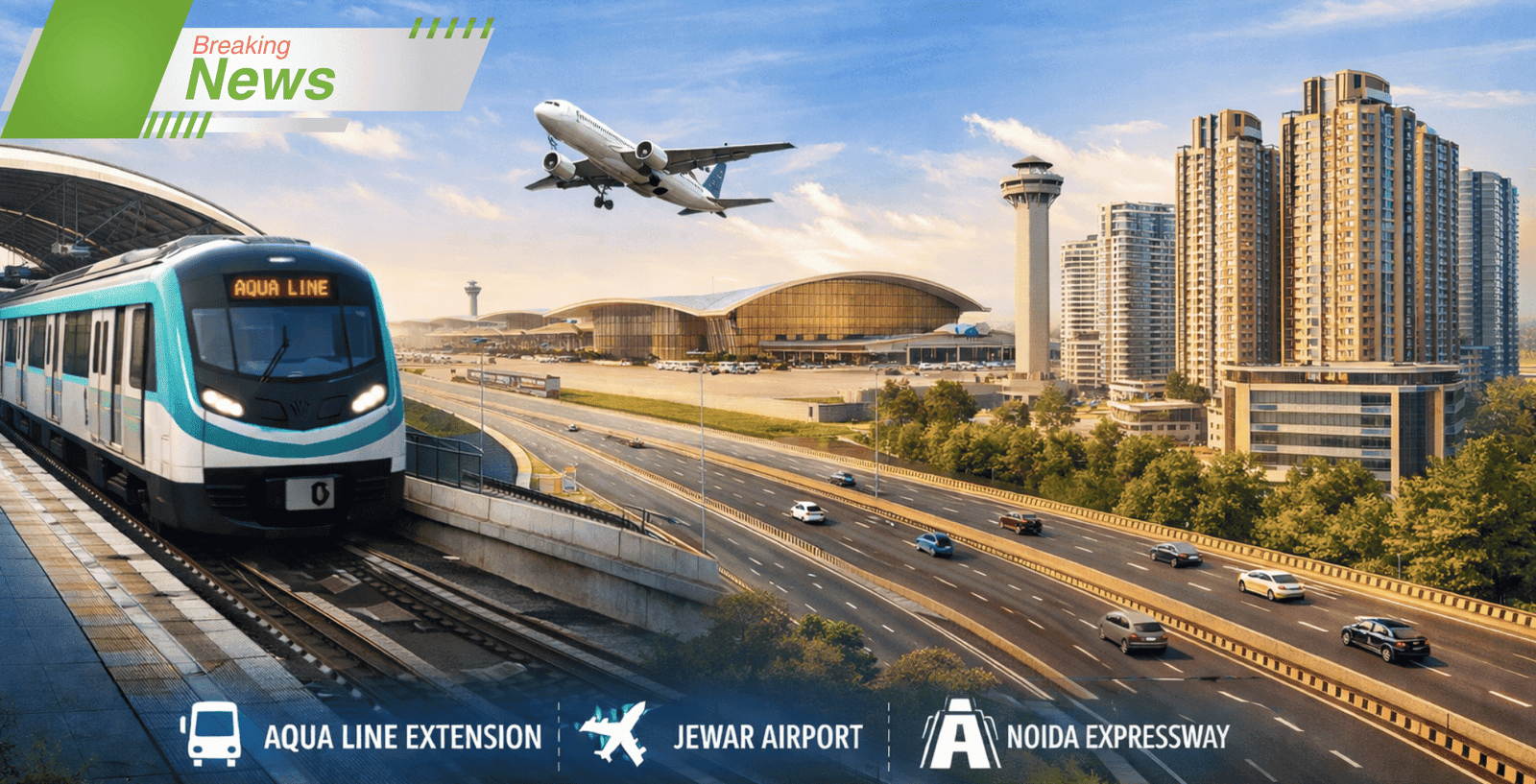
The real estate market across Noida and **Greater Noida has already been on a strong growth curve—but a fresh infrastructure push is now expected to accelerate momentum further.
In a major development, the Union Cabinet of India has approved a ₹2,254 crore new metro route project. The proposed extension is a 11.56-km stretch of the Aqua Line with 8 stations, aimed at improving last-mile connectivity along key residential and commercial zones.
What’s approved: Aqua Line extension with 8 stations
As per the approved plan, the 11.56-km Aqua Line stretch will include:
-
Botanical Garden
-
Noida Sector 44
-
Noida Office
-
Noida Sector 97
-
Noida Sector 105
-
Noida Sector 108
-
Noida Sector 93
-
Panchsheel Boys College
This corridor is expected to create smoother movement for daily commuters—especially professionals working in IT and corporate hubs along the Noida–Greater Noida Expressway belt.
Seamless interchange with Delhi Metro lines: Why it matters
Once operational, the new corridor will provide a seamless interchange between:
-
Delhi Metro (Blue + Magenta lines)
-
Noida Metro Rail Corporation Aqua Line
This is expected to directly reduce travel time to major railheads, airports, inter-state bus terminals, and key Delhi locations—making high-rise living and RWA society clusters in Noida–Greater Noida more commute-friendly.
Experts: “This bridges a long-standing connectivity gap”
Real estate experts believe the corridor will solve a major gap for commuters along the ~25 km Noida Expressway stretch and Greater Noida residents, reducing the dependency on interchange at Sector 52.
They also feel this metro boost complements the region’s “future-ready” positioning due to the combination of metro expansion, expressways, and the upcoming international airport.
What industry leaders are saying
Yash Garg, Director, M3M Noida, said the Aqua Line extension, airport development, and expressway upgrades together form a strong base for long-term growth anchored in sustainability.
Pawan Gupta, CEO, FarmlandBazaar.com, noted that stronger metro connectivity is making Noida–Greater Noida increasingly preferred among NCR homebuyers, especially working professionals planning to relocate.
Mohit Mittal, CEO – MORES, added that the metro extension and the airport are “big positives,” and that improved infrastructure is driving strong end-user interest (not just investor-led activity), supporting steady and sustainable appreciation in well-connected micro-markets.
Jewar Airport effect: Confidence is already rising
The upcoming Noida International Airport (Jewar) is already influencing sentiment across the real estate ecosystem. Experts believe this infrastructure wave could trigger faster demand growth in:
-
Residential (end-users + upgrader families)
-
Commercial (offices, business parks, co-working)
-
Retail (high-street + community retail + malls in emerging pockets)
The logic is straightforward: better connectivity reduces travel time, expands job catchments, and encourages both residential and commercial development around key nodes.
Key takeaway for buyers & investors
With the new metro corridor approval and the airport-led development cycle, Noida–Greater Noida is building a strong case as a high-potential NCR real estate hub—particularly across micro-markets that are:
-
Near metro stations / interchange points
-
Aligned with expressway connectivity
-
Positioned for airport-driven business activity
FAQs
1) How will the new metro corridor impact Noida–Greater Noida real estate?
Metro expansion typically improves accessibility and reduces commute friction—often increasing demand for housing and commercial space around station catchments and expressway-linked zones.
2) Which areas could benefit most from the Aqua Line extension?
Areas near the proposed station belt and along the Noida–Greater Noida Expressway corridor are expected to see stronger traction due to improved daily commute convenience.
3) Is this growth investor-driven or end-user-driven?
Experts highlighted increasing end-user interest, alongside investor activity—suggesting healthier, more sustainable demand rather than purely speculative movement.
4) Why is the Jewar Airport such a big catalyst?
International airports create multi-layered growth: jobs, warehousing/logistics, hospitality, corporate expansion, and new infrastructure upgrades—often increasing real estate demand in surrounding regions.
5) Will this improve connectivity to Delhi Metro?
Yes—once operational, the corridor is expected to create seamless interchange connectivity with Delhi Metro lines and NMRC Aqua Line, improving overall NCR movement.
6) Does better connectivity always increase property prices?
Not always immediately, but it often improves liveability + rental demand + buyer preference. Micro-markets with strong job access and transit connectivity tend to show steadier appreciation over time.